Skip navigation menu
Hero background image

together we can

Dear Neighbor

"Dear Neighbor"

Over the course of the campaign, engaged citizens and neighbors ask us questions about where we stand on specific issues and problems facing our nation and communities. In addition to sending direct answers, we also post our response here in our "Dear Neighbor" section so that others can learn where we stand on particular issues. If you have a question for us, complete the form to the right and we will get back to you!

<p>Reflections on a weekend of sorrow, grief and protest as we remember Renee Nicole Good and those values she defended.</p>

Reflections on a weekend of sorrow, grief and protest as we remember Renee Nicole Good and those values she defended.

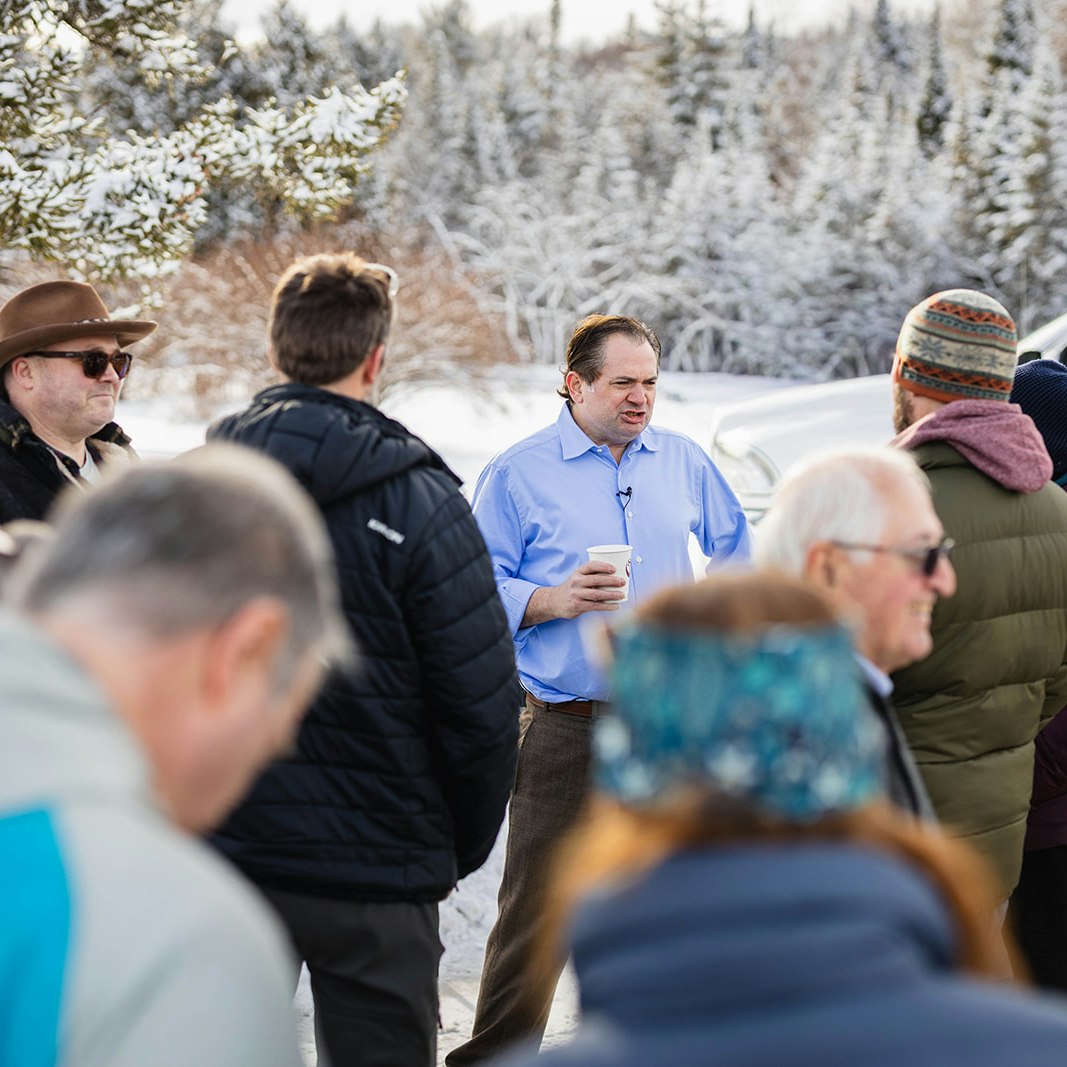
This past weekend, like so many of our neighbors across New York and throughout the country, I attended gatherings to remember Renee Nicole Good. We shared our sorrow—and our strength—not only through our presence, but through our collective voice in song. At the candlelight vigil I attended in Potsdam, New York, we gathered and sang the powerful civil rights anthem We Shall Overcome —an act of solidarity in the face of an avoidable and unnecessary loss.

The words of that song resonate deeply.

Yes, we are not afraid.
Yes, we shall live in peace.
And yes—despite all that confronts us—we shall overcome.

I believe this to be true. And yet, the events we face today, and the ongoing actions of this administration, cast a long shadow over the hope so desperately needed to sustain this righteous struggle. Too often, we are confronted by tragedies like the loss of Renee Good. Too often, we feel ourselves pulled toward darkness and despair.

Renee Good—a devoted wife and a mother of three—heard that collective American conscience and answered its call. She sought to help her neighbors and her community by exercising her constitutional right to protest. 

Contrary to what this administration has suggested, my fellow Democrats—while holding serious concerns about the current practices and methods of ICE—believe deeply in respecting law enforcement and the vital work officers do every day to protect our communities, uphold the law, and put themselves in harm’s way in service to others. I, along with my Democratic neighbors and most Americans, recognize and firmly believe that the vast majority of law enforcement professionals serve with integrity, courage, and a strong sense of duty, and that we owe them our respect and gratitude for that service.

But respect for law enforcement does not excuse or permit abuses of the public trust. This should not be an extremist position. In a democracy, accountability to reasonable and appropriate standards of conduct is an expectation we place on everyone. 

And in keeping with this, I support a comprehensive investigation to fully understand what occurred to Renee Good, but it is essential that this process be transparent and not designed to shield those who may bear responsibility. Unfortunately, there is legitimate reason to question this administration’s commitment to transparency and accountability—particularly in light of public statements made before all the facts were known, statements that appeared to prematurely absolve ICE agents of any wrongdoing, as well as efforts to prohibit Minnesota law enforcement from participating in the investigation, as is standard practice.

But regardless of the investigation’s ultimate outcome, it is important to recognize that this tragic death is the direct byproduct of this administration’s approach to immigration policy and enforcement. This administration has intentionally implemented practices in a manner that generate widespread fear, anger, and resentment within our communities—conditions that naturally compel citizens to exercise their constitutional right to protest in defense of their neighbors. At the same time, President Trump has repeatedly advanced a narrative portraying these protesters as criminals and un-American, often implying that law enforcement is justified in detaining or harassing American citizens engaged in peaceful protest and the lawful exercise of their rights.

As Americans, defending our constitutional rights is a sacred duty—whether it is the First Amendment right to free speech or the Second Amendment right to bear arms. Our belief in the Constitution cannot be selective. We do not get to choose which rights to defend, or which people deserve them. To be American is to stand up for all rights and all people.

By deploying newly hired ICE agents into volatile situations in a militarized fashion—while implicitly or explicitly encouraging disregard for the constitutional rights of U.S. citizens—and by escalating inflammatory rhetoric designed to polarize the nation, this administration has created a powder keg within our country and our communities. Under these conditions, a tragedy like this was not only foreseeable—it was inevitable.

As we watch the current administration repeatedly attack the values of a nation we all love, and as we witness the senseless loss of life that results, how can any of us avoid the crushing weight of grief, sorrow, and despair?

These emotions are deeply human. But we must also remember a fundamental truth: the light of this nation and its people cannot—and will not—be extinguished by the darkness of this moment.

I hold fast to this belief for one simple reason: I refuse to surrender hope or faith in the American people. Despite daily evidence that might suggest otherwise, I believe that beneath layers of division and mistrust lie enduring springs of shared values and truth. Though too often hidden from view, these deep currents connect us through a simple and powerful conviction—that we all want a better tomorrow for ourselves, our families, and our nation than the one we face today.

These are not Democratic virtues or Republican virtues, liberal beliefs or conservative beliefs. They are American values—human values. I believe that most Americans can look at what happened to Renee Good and recognize a simple, painful truth: this should not have happened, and Renee Good should still be alive.

While I refuse to relinquish hope, we must acknowledge that the forces aligned against us are strong. If we are to prevail as a people and as a nation—and if we are to prevent another tragedy like this—we must remember that hope is not passive. Hope is not the belief that things will simply work out. Hope is the conviction that we can build a better tomorrow than today, provided we are willing to work for it and fight for it.

This work that hope demands is not easy, and we may have to endure darkness a little longer. But morning will come—and with it, the light of freedom and democracy.  Renee’s sacrifice must not weaken our resolve through despair; it must strengthen it through hope. We must resist the temptation to let our pursuit of righteousness harden into rage, or our sorrow turn into hatred. We must cling to hope and commit ourselves to the work it demands—by showing up on street corners in protest, by casting our ballots in defense of democracy, and by engaging fully in our civic duty, demanding that our representatives in Congress fulfill their constitutional responsibility of oversight and ensure that the executive branch faithfully upholds the Constitution.

And finally, we must remember the deeper promise contained in the words we sang together in Potsdam—that sacred commitment we share as stewards of this nation’s enduring light. Even in darkness, we shall not be afraid. Despite the despair of the day, we shall live in peace. And even in the shadowed valleys of loss and sorrow, we shall overcome.

God bless all of us. God bless Renee Good.
And God bless the great United States of America. Thank you.

<p>Statement on U.S. Military Action in Venezuela<br></p>

Statement on U.S. Military Action in Venezuela

Those who know me well know that I have deep and lasting friendships within the Venezuelan community. Through those relationships, I have come to understand—personally and painfully—the brutality of life under Nicolas Maduro’s rule. In the aftermath of the recent U.S. military action inside Venezuela to arrest Maduro, I spoke first with trusted Venezuelan friends to hear their perspectives before finalizing my own.

Their message was clear and unwavering. They despise Maduro and the atrocities his regime inflicted on their families and communities. One friend told me about a seventeen-year-old girl from her hometown who was arrested in the middle of the night for participating in political protests and sent to El Helicoide, the regime’s notorious torture center. She was permitted a single phone call to her family. During that call, she said she would rather die than endure another day of torture. Another friend spoke of a widely respected former mayor arrested by the regime’s secret police for supporting the opposition. He was tortured and later died in that same prison. As my friend explained, “We do not leave our country out of preference, fashion or ambition. We leave out of fear for our lives, simply for trying to exercise basic freedoms.”

Since the death of Hugo Chavez in 2013, Venezuela has been ruled by Nicolas Maduro not through consent, but through fear, coercion, and violence. Political opponents were jailed, tortured, and killed. Journalists were silenced. Protesters disappeared. The basic pillars of democracy—freedom of expression, freedom of the press, civil liberties, and self-determination—were systematically dismantled starting with Chavez and continuing under Maduro. To oppose the regime was to risk imprisonment, torture, or death.

The consequences of this repression did not stop at Venezuela’s borders. Economic mismanagement, corruption, and hyperinflation fueled mass poverty, food and medicine shortages, and the collapse of public services. One in five Venezuelans fled the country, creating one of the largest mass migrations in modern Latin American history. For a time, the United States recognized this humanitarian catastrophe by offering protection to those fleeing persecution through asylum and temporary protected status—protections later eliminated by the Trump administration, even as it acknowledged conditions severe enough to justify military intervention.

Maduro’s regime further entrenched itself through alliances with drug cartels and criminal networks, enabling narcotrafficking with the consent—and often assistance—of the Venezuelan state. At the same time, the regime aligned itself with governments hostile to U.S. interests and basic human rights. Venezuela’s vast oil reserves became a focal point of global geopolitics, benefiting adversarial foreign powers while sanctions aimed at punishing the regime also deepened civilian suffering and raised energy costs worldwide, including here at home.

There is no serious debate about who Nicolas Maduro is. He is a dictator. A criminal. A man who brutalized his own people, facilitated drug trafficking, and aligned himself with our adversaries. That reality is broadly accepted by the international community.

The critical question, however, is not whether Maduro is a criminal dictator—but whether that fact justifies unilateral U.S. military action. And if so, where does that logic end? Cocaine moved through Venezuela, but the drug killing the most Americans today is fentanyl, whose chemical precursors largely originate in China—a country with its own grave human rights abuses. Does that mean we should send our military to remove Xi Jinping? What about Iran, Russia, or North Korea? By the standard employed by the Trump administration, war could be justified with nearly any adversarial nation.

The Trump administration will argue that anyone who questions this military action must be indifferent to Maduro’s crimes and their effect on our nation. That false, zero-sum narrative is both dishonest and dangerous. It ignores the reality that there are alternatives to invasion—tools that can hold dictators accountable without destabilizing nations, endangering civilians, sacrificing American lives, or undermining international law.

We are a nation founded on the rule of law, respect for sovereignty, and the belief that people have the right to determine their own futures. Those principles cannot be applied selectively. No matter how reprehensible a foreign leader may be, the United States does not possess the inherent authority to invade a sovereign nation and impose change at the barrel of a gun if we are not under threat ourselves.  America must always oppose oppression. But we must do so in ways that reflect our values—not merely our power—and that do not deepen the suffering of those already living in fear and uncertainty.

This decision was not only wrong morally and legally—it was wrong from a national interest standpoint. History repeatedly shows that military intervention without legitimacy, planning, and international consensus often replaces one crisis with another. And now that unilateral action has been taken, we cannot simply walk away. Our actions have created a new reality in Venezuela, and with it comes responsibility—for stability, humanitarian relief, civilian protection, and the conditions necessary for genuine democracy to emerge. Once again, America risks finding itself engaged in nation-building.

When I asked my Venezuelan friends how they felt about Trump’s actions, despite their hatred of Maduro, their response was uncertainty and fear, despite the desire to celebrate Maduro’s removal. They fear what comes next. They fear this intervention was driven primarily by oil interests, and that it will result in deals that preserve corruption while doing little to improve the lives of ordinary Venezuelans or to stem the drug trafficking that continues to destabilize the region.

I will lose no sleep over Maduro’s personal fate; whatever justice he faces is of his own making. And while I share my Venezuelan friends’ hope for a free and prosperous Venezuela, I do not believe that outcome will be achieved through Trump’s use of military force. I believe our own national interest will be weakened—especially if we are ultimately forced to commit troops to secure stability and impose a desired outcome. If this intervention leads to backroom deals that preserve the corrupt power structures of the remaining Maduro regime in exchange for favorable oil terms while leaving the machinery of repression intact, the United States will lose enormous moral authority on the world stage.

I also have other profound and growing concerns heightened by Trump’s recent actions: the fate of Venezuelans who sought refuge in the United States. I have long and strongly opposed the decision to end Temporary Protected Status for Venezuelans. The international community has widely recognized the grave dangers faced by people living under the Maduro regime—and Trump himself implicitly acknowledged those dangers by claiming conditions justified military action. Yet despite this recognition, his administration stripped protection from Venezuelans who fled brutality, sought asylum in good faith, and were promised safety by the United States government.

The deportation of these individuals has already been devastating for our communities, but my newest concern is what awaits those who are returned after this military action—especially as Kristi Noem and officials have indicated deportations will continue, sending people back to a regime that remains firmly in power and seeks retribution. We must honor the promise we made to these brave individuals. Temporary Protected Status must be immediately reinstated for Venezuelans who were previously approved, and deportations of those who held protected status must be halted at once.  

It is tragic that this lesson remains unlearned. Throughout our history, America has been reminded that the true measure of leadership is not found in how swiftly or forcefully we wield power—but in whether we possess the wisdom to act in ways that genuinely advance freedom, stability, human dignity, and our national interest. 

<p>Joy Asks, "Where do you stand on LGBTQ+ Issues?"</p>

Joy Asks, "Where do you stand on LGBTQ+ Issues?"

Dear Neighbor,

Thank you for your question about where my campaign and I stand on issues related to the LGBTQ+ community. To begin, I want to apologize for launching our website before publishing a position paper on this important topic. Regardless of whether neighbors ultimately agree with my views, I believe every candidate for public office has a responsibility to clearly state their position.

I’d like to start by addressing the stalled Equality Act. If passed, this legislation would strengthen existing civil rights protections by explicitly including sex, sexual orientation, and gender identity as protected categories. It would prohibit discrimination in employment, housing, public accommodations, jury service, and education. For far too long, LGBTQ+ Americans have faced barriers to fully participating in our democracy and our communities. As a Nation, we must pass the Equality Act to ensure that all Americans are afforded the freedoms and liberties promised by our Constitution and by the ideals of our democracy.

To make this legislation meaningful, we must also reverse the long-standing erosion of funding for the Department of Justice Civil Rights Division so that hate crimes and discriminatory actions are fully investigated and prosecuted.

I have also spoken extensively about the need to improve the affordability, reliability, and accessibility of healthcare in Northern New York. Unfortunately, the weaknesses in our healthcare systems are often felt even more acutely by our LGBTQ+ neighbors. Discrimination, intolerance, and social stigma contribute to higher rates of mental health challenges, including depression and anxiety. While mental health concerns affect people from all backgrounds, we must ensure that LGBTQ+ individuals have reliable access to culturally competent care from providers who understand the unique challenges and trauma this community faces.

There are, however, certain areas where my position may not align fully with all LGBTQ+ individuals or advocacy organizations. While I firmly believe in ending discrimination and ensuring that every person can enjoy the full liberty and freedom our Nation promises, we must also respect the rights of others. For example, although I do not believe religious freedom should generally be used as a justification for discrimination against the LGBTQ+ community, I do believe there are limited exceptions. Most importantly, religious sacraments and rites must be considered distinct from “public accommodations” as defined under the Equality Act. While I sincerely hope that faith communities continue to become more inclusive, I do not believe the Government should impose doctrinal mandates on religious institutions.

Lastly, I recognize that the questions surrounding gender identity and competitive fairness in sports are complex and sensitive. I believe that athletic organizations and governing bodies should retain the ability to develop policies that balance inclusion with fairness and competitive integrity.

I hope this provides a clear understanding of where I stand on issues affecting our LGBTQ+ neighbors. If you have any follow-up questions or would like to discuss further, please do not hesitate to reach out.

Sincerely,
Stuart Amoriell
 

<p>Elise Stefanik Ends Bid for Governor and Announces She Will Not Seek Reelection to Congress</p>

Elise Stefanik Ends Bid for Governor and Announces She Will Not Seek Reelection to Congress

The holiday season has brought a welcome gift for Northern New York with Elise Stefanik’s announcement that she is ending her campaign for governor and will not seek reelection to Congress in New York’s 21st District. While Stefanik entered Washington presenting herself as a fair-minded, rational centrist, she quickly embraced the extremist positions of the Trump administration—positions that have weakened our economy and harmed communities across Northern New York. And while she may be exiting stage left from New York politics, we must not lose sight of the fact that she remains the sitting congresswoman for the 21st District, and the policies she advanced and supported continue to affect our neighbors every day.

This moment, therefore, demands action. We cannot afford complacency or the false belief that her departure alone will end the damage caused by those policies. Instead, we must seize this transition as an opportunity to clearly and confidently make the case to Northern New York about why Democratic and progressive solutions are the right path forward for rebuilding our economy and strengthening our communities.

Those running for office must resist the temptation to water down their beliefs in the misguided hope that doing so will win back voters who once supported Stefanik. That approach is not how we win—and it is beneath the values we claim to stand for. Now is not the time to weaken our message; it is the time to engage our neighbors honestly, to communicate clearly what we stand for, and to explain why our solutions are better equipped to address the challenges facing New York.

We must also recognize that many who supported Stefanik did so believing her policies might offer answers to the real problems confronting our communities: rising healthcare and housing costs, stagnant wages, high inflation, and a shrinking workforce. Those same voters are now seeing that her policies failed to solve these challenges. This is our moment to speak boldly—to shout from the High Peaks what we stand for—and to reject the timidity that leads us to hide our convictions out of fear of losing votes. That is how causes and elections are lost, not won.

We must make the case to all those seeking fairness, justice, liberty, and equality that they have a home in the Democratic Party. To those fighting for stronger local economies, food security, affordable and reliable healthcare, affordable housing, and better-funded teachers and schools: you have a home with us.

The challenges we face today are immense, and if we are to rise to meet them, we must rise together—united as one Nation, Indivisible. Together We Can.

<p>The ongoing debate about military action in Venezuela</p>

The ongoing debate about military action in Venezuela

Today, White House Press Secretary Karoline Leavitt issued the following statement:

“President Trump has made it well known that acquiring Greenland is a national security priority of the United States, and it’s vital to deter our adversaries in the Arctic region. The president and his team are discussing a range of options to pursue this important foreign policy goal, and of course, utilizing the U.S. military is always an option at the commander in chief’s disposal.”

This is not fake news or propaganda. It is a verbatim statement from the White House Press Secretary. Coming just days after U.S. military action in Venezuela, it openly raises the possibility that the United States could use force to take control of Greenland.

I recognize and respect that people in our North Country communities hold differing views on how best to secure our nation and advance our shared goals. I firmly believe, however, that we all want what is best for our neighbors, our communities, and our country. I believe deeply in our democracy and welcome open, respectful dialogue with those who see things differently than I do.

In that spirit, I am addressing this statement not only to the Democratic voters involved in the upcoming primary election, but to all Americans—Republicans, Democrats, and Independents alike. Some issues transcend elections and matter more than political gain.

As Americans, we share far more in common than we often acknowledge in today’s political climate. We all want a safe, secure country where we can raise families, express our freedoms and build a strong future for ourselves and our loved ones. While we may disagree about how best to achieve these goals, those disagreements are healthy in a democracy—so long as we engage one another with respect, allow room for dialogue, and work together to solve real problems rather than demonizing those we disagree with.

This divide has been especially evident in the debate following the military action in Venezuela. In recent days, much of the public conversation has been marked by insults and vitriol rather than substantive discussion. I do not believe this reflects where most Americans stand, nor does it represent our best selves. America is a great nation, but we must do better when confronting serious challenges.

Few people believe Nicolas Maduro was a legitimate leader. He was a brutal dictator who enriched himself at the expense of his people and oppressed the Venezuelan nation. No reasonable person—Democrat or Republican—defends Maduro or mourns his downfall. However, many Americans have raised serious concerns about the manner and legitimacy of his removal—not out of concern for Maduro himself, but out of concern for upholding American ideals and protecting our long-term national security interests.

That concern is straightforward: violating national sovereignty through military force, rather than pursuing alternative means, can ultimately weaken our own national security. Reasonable people can and should debate this point, even if they ultimately don’t agree. Today’s statement from the White House regarding Greenland reinforces those fears.

The idea of using military force to take control of an independent territory such as Greenland poses a serious threat to U.S. national security. It undermines international treaties and alliances that help maintain global stability and protect not only the United States, but the broader international community. Such actions risk alienating our allies and creating more conflict—not less. As the prime minister of Denmark said today, a U.S. incursion into Greenland would mean the end of NATO.

Whatever national security benefit might be gained by taking Greenland by force would be vastly outweighed by the damage caused by the collapse of our international alliances. The only beneficiaries of such actions would be our adversaries. This is precisely the danger many of us warned about when raising concerns over the military action in Venezuela.

Again, while we may not all agree, I urge those who care about this country not to dismiss disagreement as anti-American. Instead, we should welcome dialogue, ask serious questions, and engage one another in good faith. In that spirit, I invite anyone who wishes to respond to do so respectfully and thoughtfully—without insults, and with a genuine interest in understanding this critical issue.